Mining has always been a balance between efficiency and precision. Every tonne of material moved carries an associated cost, whether it is ore or waste rock. In underground operations, even minor inaccuracies in drilling, blasting, or surveying can create dilution, increase waste, and reduce profitability. Industry estimates suggest that dilution alone can account for 10 to 30 percent of all material extracted in some operations, meaning a large portion of what is mined generates no revenue yet still incurs hauling and processing costs.
A closer look at daily operations reveals the root causes of waste. Decisions at the face are often made with outdated or incomplete data. Survey schedules may lag behind production, forcing engineers to rely on visuals rather than verified measurements. Variability in orebodies further compounds the issue. Without near real-time insight into the geometry of a heading, teams risk drilling patterns that either miss ore or overbreak into waste rock.
This cycle is not only costly but also resource intensive. Every additional tonne of waste handled represents lost productivity, unnecessary fuel consumption, and greater environmental impact.
Traditional Solutions: Incremental Improvements, Not Transformation
Mining companies have long recognized the importance of minimizing waste. Historically, solutions have centred on incremental improvements: more precise survey intervals, refined drill-and-blast techniques, and better operator training. While these have delivered improvements, they have been limited by the speed at which data becomes available.
For example, conventional survey methods can reduce dilution by up to 10 percent when applied consistently, according to industry benchmarking. However, the challenge is timing. Surveys often lag production by days or weeks, leaving little opportunity to adjust patterns in real time. By the time a discrepancy is identified, the waste has already been mined, hauled, and processed.
What the industry has needed is a way to close the gap between production and planning. Enter in-motion LiDAR.
In-Motion LiDAR: Creating Actionable Data at the Face
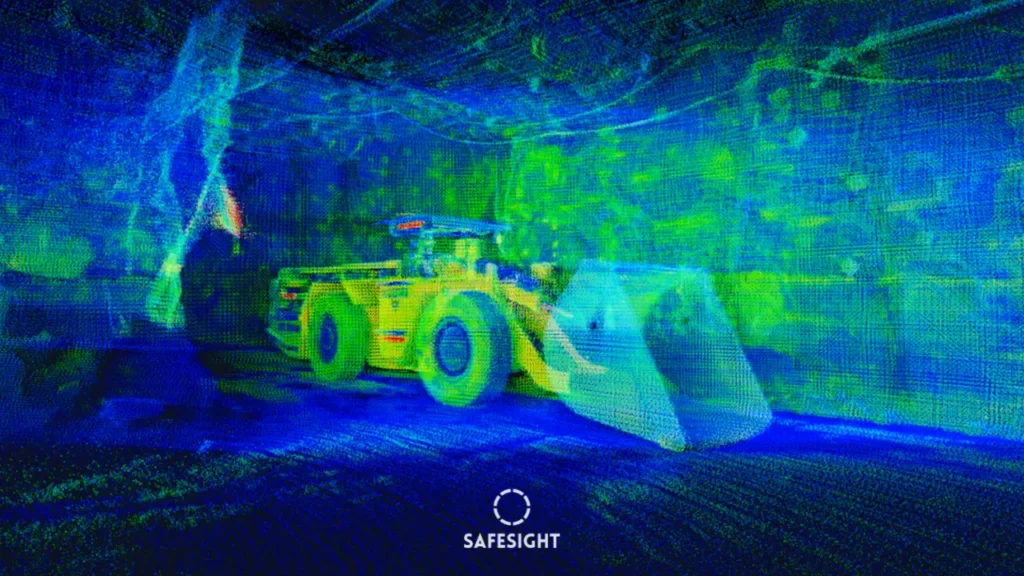
In-motion LiDAR scanning has transformed how mines capture and use data. Instead of waiting for static survey intervals, these mobile systems capture accurate, measurable 3D geometry of each face as it is exposed. Engineers receive this information almost immediately, enabling them to validate or adjust drill patterns for the next round.
The value lies in responsiveness. When blast results deviate from the model, planners can make subtle but critical adjustments in hole layout, charge weight, or orientation. Over time, these incremental changes add up to significant reductions in waste and dilution. More importantly, they preserve ore grade and ensure that every tonne of material moved has the highest possible contribution to revenue.
SafeScanner: Flexible Configurations for Every Mine
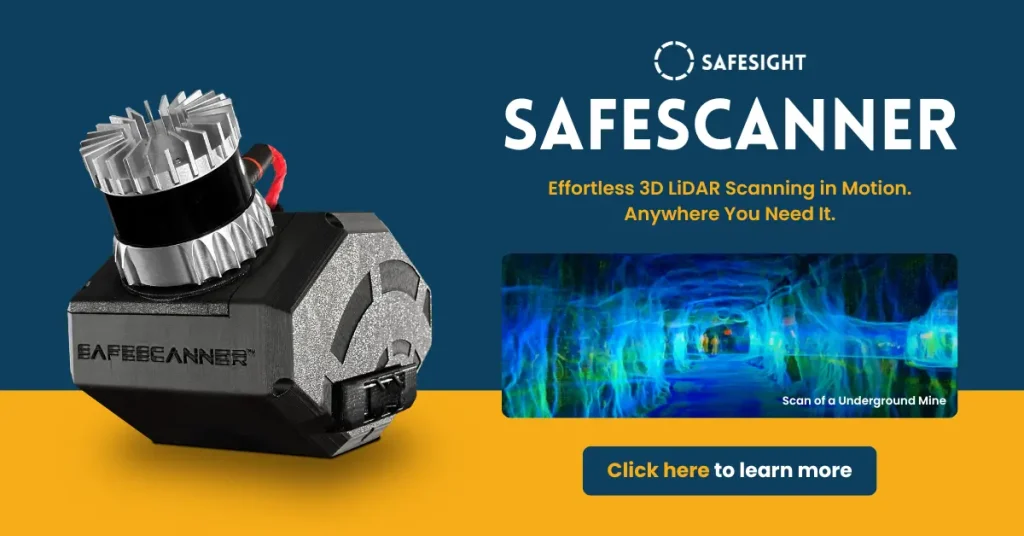
At SafeSight, we built the SafeScanner to take the promise of in-motion LiDAR and make it practical for every operation. The system is designed with multiple configurations to adapt to specific mining environments and workflows.
Handheld SafeScanner:Perfect for quick inspections and confined spaces where mobility is key. Operators can capture data at the face within minutes and feed it directly into planning tools.
DeepTraxx Rover with SafeScanner:For areas that are unsafe or difficult to access, the rover-mounted system brings scanning power to the heading without exposing personnel to risk.
DB4 Drone Mounted SafeScanner:Designed for broader coverage, this configuration integrates into existing mining equipment, making data capture seamless within normal cycles.
Vehicle-Mounted SafeScanner:Ideal for rapid coverage of drifts and haulage routes. The system scans while vehicles move through headings, maximizing productivity without slowing operations.
This flexibility ensures that no matter the mine layout or production schedule, SafeScanner can be deployed in a way that captures the right data at the right time.
The Measurable Impact: Waste Reduction and ROI
The results speak for themselves. Based on SafeSight’s impact brief, a mine producing 1,000 tonnes per day with an average ore grade of 4 grams per tonne and a recovery rate of 90 percent can reduce waste handling by 3 percent through SafeScanner-enabled real-time mapping
Read more about the impact: Download our Impact Brief
- That equates to 30 tonnes of waste avoided every day.
- Preserving ore grade from this reduction means recovering an additional 3.9 ounces of gold daily.
- At $2,300 USD per ounce, that is nearly $9,000 per day in value preserved.
- Annualized, the benefit totals more than $3.2 million in added value.
This calculation reflects just one scenario. As operations scale, the savings multiply. Even more compelling, SafeScanner’s capability can extend beyond a 3 percent improvement. With consistent adoption, mines are well positioned to achieve 5 percent reductions in waste,representing a significant shift in efficiency and sustainability.
Why SafeScanner is the Best Solution
What sets SafeScanner apart is not just the technology but the practicality. In-motion LiDAR is only as valuable as its ability to integrate into everyday mining workflows. SafeScanner’s modular design means data capture is quick, simple, and repeatable. Operators do not need to disrupt production schedules to gather critical information. Engineers do not need to wait for survey updates. Decisions can be made on the same shift, supported by accurate 3D data.
The result is a closed-loop system where every round informs the next, waste is minimized, and ore recovery is maximized. This is how mining companies can reduce waste by 5 percent without adding complexity or overhead.
The Call to Action: Why Wait?
Mining companies are under pressure to operate more sustainably, improve efficiency, and deliver stronger returns. Waste reduction is one of the clearest ways to meet all three objectives at once. The technology to achieve it exists today, and the return on investment is proven.
The real question is not whether mines can afford to adopt in-motion LiDAR but whether they can afford not to. Every day without this technology represents tonnes of waste hauled, processed, and paid for unnecessarily.
If your operation is not yet investing in in-motion LiDAR, what are you waiting for? SafeScanner provides a flexible, proven pathway to higher efficiency, lower waste, and stronger ROI.
Learn more about how SafeScanner can deliver these results for your mine at: www.safesightxp.com/safescanner
Watch the SafeScanner In Action