
GROUND MAPPING BRIEFING 01
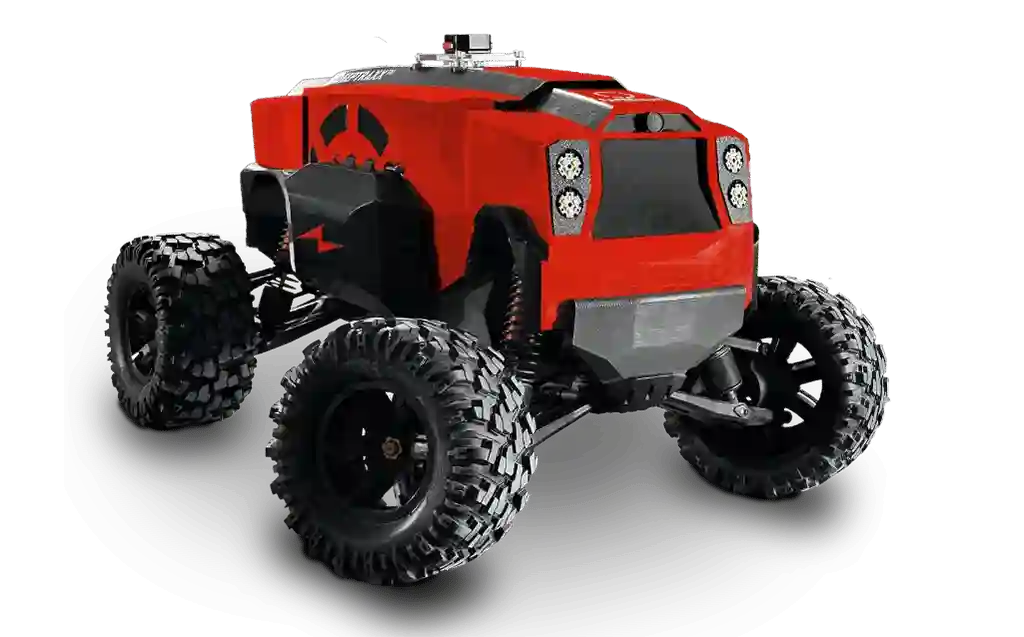
DeepTraxx Underground Inspection Robot
Get the Inspection Done. Without Making Access the Job.
DeepTraxx is SafeSight's ground-based underground inspection and mapping rover, designed to carry sensing technology through difficult, hazardous and access-constrained environments.
Your route. Your inspection cycle. Your numbers.
200 LB
Towing Capacity
30 LB
Payload Capacity
200 M
Analog LOS Range
2 HR
Battery Runtime
When Access Becomes the Bottleneck
The inspection area is not always the easy part of the mine to reach. Unsupported ground, muck, debris, restricted zones or operational conditions can make access more complicated than the inspection itself.
Traditional equipment still has to be positioned where it can see or measure the target. Every setup consumes underground time.
The people collecting information are not always the people who ultimately need it. Operations, survey, geotechnical and engineering teams need reviewable information they can use afterward.
Finding missing data after leaving the area creates another: travel → setup → capture → processing cycle.
The problem is not always the inspection. Sometimes the problem is everything required just to reach the inspection.
When Flight Isn't the Answer, Send the Scanner on the Ground.
Some underground openings are ideal for aerial mapping. Others are not. DeepTraxx provides SafeSight with a ground-based mobility platform for environments where wheels or tracks offer the more practical path to the data. Deploy SafeScanner on DeepTraxx to move LiDAR through difficult ground conditions while collecting measurable 3D geometry.
DEEPTRAXX
= MOBILITY
SAFESCANNER
= 3D DATA CAPTURE
GROUND-BASED UNDERGROUND INSPECTION + MAPPING
DEPLOY
Move DeepTraxx to the underground operating location.
DRIVE
Remotely move the rover through the inspection or mapping route.
CAPTURE
Use the selected payload to collect the required information. For LiDAR applications, SafeScanner captures the surrounding geometry.
VERIFY
Use SafeSight Live Render where applicable to review the developing point cloud and evaluate coverage.
PROCESS
Move captured spatial data into Eclipsed for processing and geo-referencing.
USE
Visualize, measure, manage or export the information into established mine-planning and engineering workflows.
One Platform. Multiple Underground Missions.
DRIFT MAPPING
Capture full drift geometry for:
- as-built documentation;
- clearance analysis;
- development tracking;
- design comparison;
- repeat mapping.
RAMP SCANNING
Capture long underground ramp geometry using a ground platform designed for mobile deployment. Support:
- clearance analysis;
- geometry & as-built documentation;
- infrastructure planning;
- repeat surveys.
REMOTE INSPECTION
Move cameras, LiDAR or other supported payloads toward areas where routine personnel access is restricted or undesirable.
DEVELOPMENT MAPPING
Create repeatable spatial records as mine development advances.
ASSET & INFRASTRUCTURE INSPECTION
Capture spatial or visual records of:
- tunnel infrastructure;
- services;
- walls & backs;
- ground-support areas;
- equipment environments;
- underground structures.
CONVERGENCE / CHANGE MONITORING
Repeated scans can support comparison of underground geometry over time. (Note: DeepTraxx provides the repeatable data that may support engineering convergence analysis).
Ground or Air? Use the Platform That Fits the Opening.
| DBV UNDERGROUND DRONE | DEEPTRAXX |
|---|---|
| Best suited where aerial mobility is practical | Best suited where ground mobility is practical |
| Cavities extend beyond accessible ground | Flight is undesirable or unsuitable |
| Stope or void geometry benefits from multiple aerial viewpoints | Linear corridors need inspection |
| Floor conditions make ground travel impractical | Ramps or drifts need mapping |
| Aerial payload stabilization is needed | The payload needs stable ground movement |
| Cannot land on debris/muck | Debris/muck/terrain can be traversed by the rover |
SafeSight does not force one platform into every opening. We fit the capture method to the environment.
Move the Sensor Instead of Moving the Inspector
| TRADITIONAL / PERSONNEL-BASED WORKFLOW | DEEPTRAXX WORKFLOW |
|---|---|
| Personnel travel to inspection area | Remote ground platform travels toward target |
| Equipment is carried/positioned | Payload moves with rover |
| Capture takes place from accessible positions | Mobile capture follows inspection route |
| Additional setups may be required | LiDAR can capture continuously while moving |
| Review may happen after leaving | Live Render can support coverage verification |
| Repeat access may be required if information is incomplete | Digital record remains available for later review |
Note: DeepTraxx is a remote information-capture platform. It does not eliminate legally required inspections, qualified personnel or mine-specific procedures.
What Is an Underground Inspection Robot?
An underground inspection robot is a remotely operated or autonomous ground platform designed to carry cameras, LiDAR, thermal sensors or other inspection payloads through underground environments.
In mining, robotic inspection can be useful where access conditions, distance, terrain or operational constraints make conventional inspection difficult.
A ground robot can provide a mobile platform for collecting visual and spatial information without requiring every sensor to remain at a fixed position.
DeepTraxx is SafeSight's ground-based platform for these applications.
Why Use a Mine Inspection Robot?
Underground mines contain environments with very different access conditions. The right inspection tool for an active drift may not be the right tool for unsupported ground, a debris-filled route, a post-incident area, a long ramp, a tunnel, or a confined infrastructure corridor.
Mine inspection robots provide another option between conventional personnel access and aerial deployment. They can carry sensing technology closer to the area requiring information while keeping the inspection record digital and reviewable.
Ground-Based LiDAR Mapping Beyond the Normal Survey Position
DeepTraxx can carry SafeScanner through underground routes while the LiDAR sensor captures surrounding geometry.
This mobile approach can support mapping across drifts, ramps, tunnels, development headings, infrastructure corridors, and access-constrained areas.
The value is not simply that the rover moves. The value is that the sensing platform moves with it.
Know What You Captured Before Leaving the Area
Capturing a point cloud is only useful if the required geometry was actually recorded.
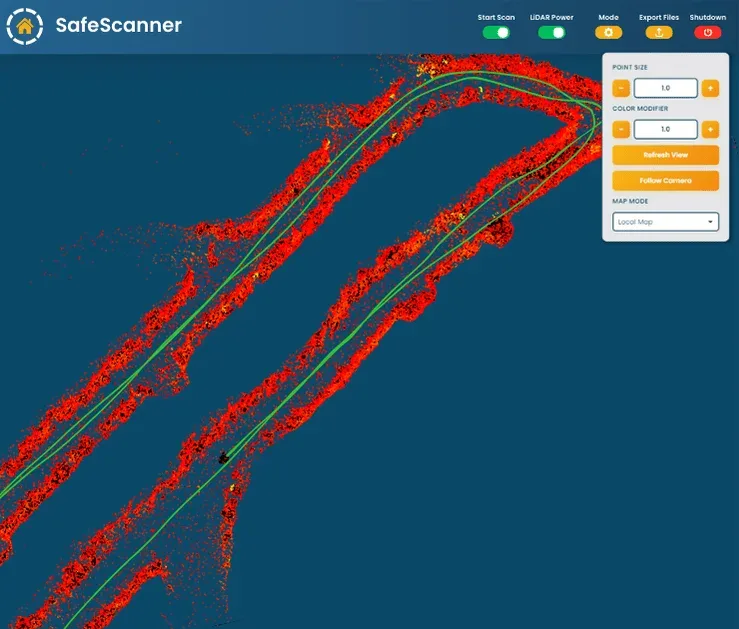
SafeSight's Live Render workflow can display the developing point cloud during compatible scans so the operator can evaluate coverage while still positioned for the job.
Verify the scan before a missing area becomes another trip.
From Underground Rover to Engineering Data
DEEPTRAXX
Ground-based access to inspection route
SAFESCANNER
LiDAR geometry
CONTROL APP
Review scan coverage
ECLIPSED
Clean and prepare point clouds
NIMBVAULT
Visualize, organize and retain mine data
MINE PLANNING / ENGINEERING
Move information into existing technical workflows
Need the Area Scanned Rather Than the Robot?
Some operations want to own and deploy DeepTraxx. Others need SafeSight to deliver the inspection or mapping result.
PRODUCT
DEEPTRAXX
Beyond Mapping: DeepTraxx Fire Response
DeepTraxx can also support specialized emergency-response configurations.
Existing SafeSight emergency-response material describes DeepTraxx Fire Response configurations supporting capabilities such as:
- remote visual assessment;
- thermal assessment;
- ground-based incident mapping;
- remote fire-suppression support.

DeepTraxx Technical Resources
Review the existing SafeSight technical material, or share your underground route with the team for an application-specific assessment.
DeepTraxx Underground Inspection Robot FAQs
What is an underground inspection robot?
An underground inspection robot is a ground-based remotely operated or autonomous platform designed to carry cameras, LiDAR or other sensing equipment through underground environments where conventional inspection access may be difficult or inefficient.
What is DeepTraxx?
DeepTraxx is SafeSight's ground-based underground inspection and mapping rover. It can carry payloads such as SafeScanner to collect spatial information through suitable underground environments.
What is DeepTraxx used for?
DeepTraxx can support applications including underground mapping, drift scanning, ramp scanning, remote inspection, infrastructure documentation and other difficult-access ground-based inspection workflows. Specialized DeepTraxx configurations can also support emergency-response applications.
Can DeepTraxx carry LiDAR?
Yes. SafeScanner can be deployed on DeepTraxx to create a mobile ground-based LiDAR mapping configuration.
How far can DeepTraxx operate?
The current SafeSight DeepTraxx page lists a 200 m analog line-of-sight range. Actual operating range depends on the communications configuration, mine geometry, environment and deployment requirements.
How long does the battery last?
The current SafeSight DeepTraxx page lists up to 2 hours of battery runtime. Actual runtime may vary with configuration, payload, terrain and operating conditions.
What is DeepTraxx's payload capacity?
The current published DeepTraxx specification lists a 30 lb payload capacity.
Can DeepTraxx tow equipment?
The current DeepTraxx page lists a 200 lb towing capacity. Suitability for any specific towing application should be reviewed with SafeSight.
Is DeepTraxx autonomous?
The current SafeSight page describes DeepTraxx as an autonomous ground-mapping rover. The exact level of autonomy, operator control and supported navigation modes depends on the approved configuration and should be confirmed with SafeSight.
How is DeepTraxx different from an underground drone?
DeepTraxx moves on the ground, while DBV is an aerial platform. DeepTraxx can be appropriate for suitable drifts, ramps and other ground-accessible routes. DBV can be better suited to openings where aerial mobility is required to reach geometry that cannot be accessed from the floor.
Can DeepTraxx map underground without GPS?
Ground-based underground mapping does not depend on normal surface GNSS/GPS positioning in the same way as conventional surface survey platforms. The final workflow depends on the sensors, control system and required georeferencing method.
Can I see the scan while DeepTraxx is operating?
Where DeepTraxx is operating with SafeScanner and the compatible SafeSight workflow, Live Render can provide real-time visualization of the developing point cloud to help evaluate capture coverage.
Does DeepTraxx replace mine inspectors or surveyors?
No. DeepTraxx is an information-capture platform. Qualified personnel remain responsible for mine-specific inspection, survey, engineering and operational decisions.
Can DeepTraxx be used for fire response?
Specialized DeepTraxx Fire Response configurations support SafeSight's emergency-response ecosystem, including remote assessment and fire response applications.