
MINE SCANNING HARDWARE 01
SafeScanner Underground 3D LiDAR Scanner
Scan While You Move. Verify Before You Leave.
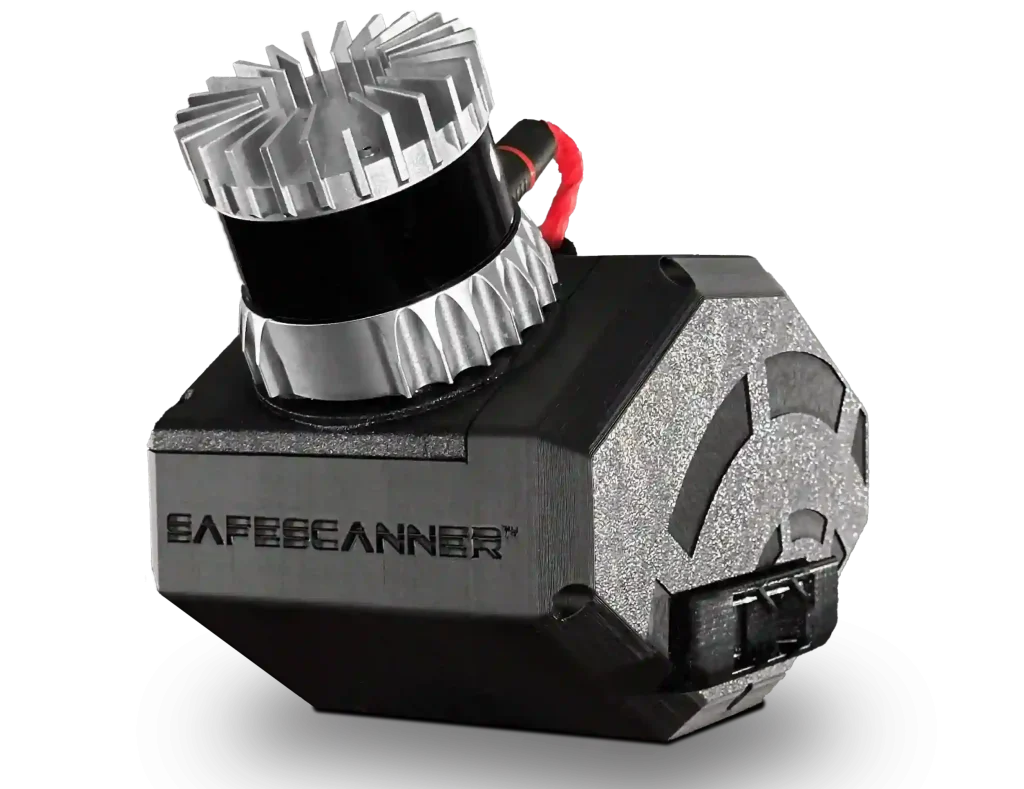
SafeScanner is SafeSight's modular underground 3D LiDAR capture system, engineered for high-density in-motion mapping across underground mining environments.
One core sensor. Multiple underground deployment methods.
±5 MM
Published Accuracy
5.2M
Points / Second
0–100 M
Published LiDAR Range
90°
Field of View
One Core Sensor.
Multiple Ways to Reach Underground Geometry.
The underground environment should determine how the scanner moves.
SafeScanner was designed as a modular capture platform rather than a scanner tied to one deployment method.
Use the configuration suited to the route, opening and data requirement.
HANDHELD
Walk the Scanner Through Accessible Areas
For accessible underground routes and detailed local capture, SafeScanner can be configured for operator-carried scanning. This handheld LiDAR scanning capability supports flexible data collection where a full vehicle or robotic platform is unnecessary.
VEHICLE
Capture Long Underground Routes in Motion
Mount SafeScanner on a suitable vehicle for mobile capture across drifts, ramps and other linear mine infrastructure. The scanner moves with the vehicle while recording surrounding geometry instead of requiring a complete stop-and-reset workflow at every measurement location.
DEEPTRAXX
Send the Scanner Where Ground Access Becomes Difficult
DeepTraxx provides a remotely operated ground platform for inspection and mapping environments where personnel or conventional vehicles are not the preferred capture method.
Explore DeepTraxxDBV
Fly the Scanner Into Suitable Underground Openings
For stopes, voids and other suitable openings where aerial mobility provides access to geometry beyond the brow, DBV carries SafeSight LiDAR into GPS-denied underground environments.
Explore DBV Underground MappingSHAFT
Capture Vertical Mine Infrastructure
SafeScanner can support shaft scanning configurations where high-density 3D geometry is required for shaft measurement, alignment and infrastructure assessment.
Explore Mine Shaft InspectionMove the Scanner Through the Mine.
not force the job around the scanner.
Traditional terrestrial laser scanning remains an excellent capture method for many surveying requirements.
But some underground tasks involve long linear routes, repeated scanning, changing development, difficult setup locations, large areas, or time-sensitive field windows.
In those environments, repeatedly stopping, positioning and re-establishing a static scanner may add significant field time. SafeScanner is designed for in-motion capture. Instead of treating every scan as an isolated station, the scanner travels through the environment while collecting the surrounding 3D geometry.
Static LiDAR or In-Motion LiDAR?
Use the Method That Fits the Survey.
STATIC / TERRESTRIAL LIDAR
Strong fit when:
- highly controlled static positions are preferred;
- the area can be efficiently observed from selected stations;
- maximum station control is required;
- field setup time is acceptable;
- the workflow is already optimized around static capture.
SAFESCANNER IN-MOTION LIDAR
Strong fit when:
- the scan route extends over significant distance;
- repeated setup positions would slow the workflow;
- mobile capture is practical;
- continuous geometry is useful;
- real-time coverage verification adds value;
- the environment benefits from handheld, vehicle or robotic mobility.
The objective is to use the right capture method
for the underground environment.
Know What You Captured
Before You Leave the Heading.
A scan is not complete simply because the scanner stopped recording.
What matters is whether the required geometry was actually captured.
SafeSight's Live Render workflow allows operators to view the developing 3D point cloud during compatible SafeScanner capture, helping them evaluate coverage while they are still positioned for the job.
WHILE THE SCANNER IS STILL UNDERGROUND.
If an area appears incomplete, the operator can identify the potential gap during the capture workflow rather than discovering it later during office processing.
Explore Real-Time Scan Verification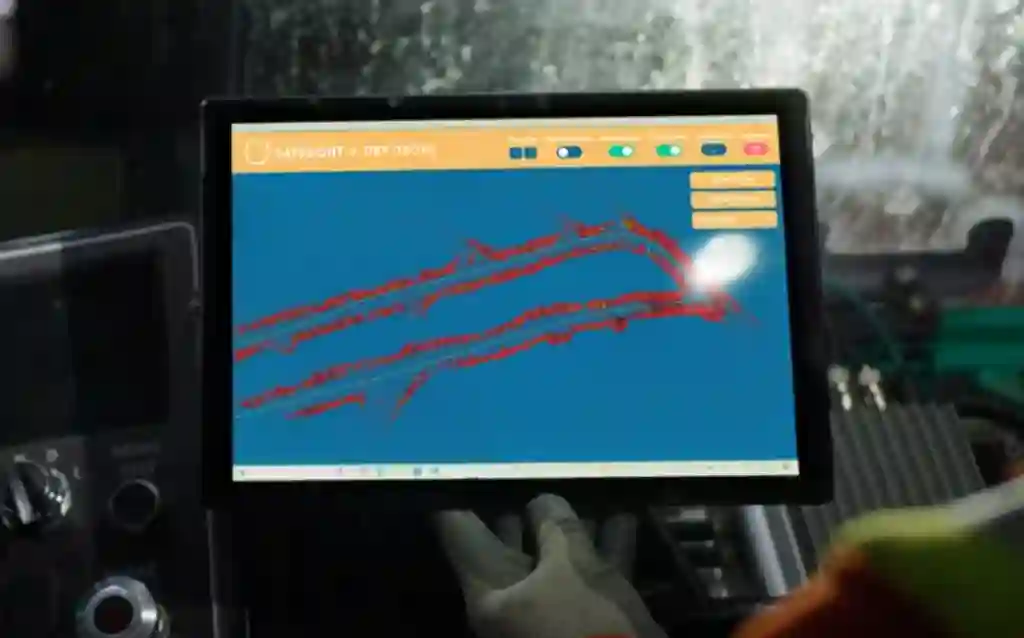
Turn Underground Space Into
Measurable 3D Geometry.
AS-BUILT GEOMETRY
Capture the shape and dimensions of existing underground development for comparison against mine designs.
DRIFT + RAMP GEOMETRY
Create continuous spatial records across suitable underground routes and infrastructure.
SHAFT GEOMETRY
Capture high-density shaft data that can support measurement, alignment assessment and infrastructure review.
STOPE + VOID GEOMETRY
When paired with an appropriate mobile platform such as DBV, SafeSight LiDAR can capture suitable cavities beyond traditional access points.
CLEARANCE
Use captured geometry to evaluate available space around underground equipment, services and infrastructure.
CHANGE OVER TIME
Repeat capture can create a digital record for comparing underground geometry between survey periods.
The Product Is Not the Point Cloud.
The Product Is What Your Team Can Measure From It.
Millions of points per second are useful only when the resulting geometry supports an actual mine decision.
SafeScanner data can contribute to workflows involving:
- as-built documentation;
- design comparison;
- underground clearance;
- shaft measurements;
- stope geometry;
- reconciliation;
- development tracking;
- infrastructure documentation;
- change detection;
- digital mine records.
USABLE GEOMETRY IS THE OUTCOME.
Don't Take the Specification Sheet at Face Value.
Inspect the Data.
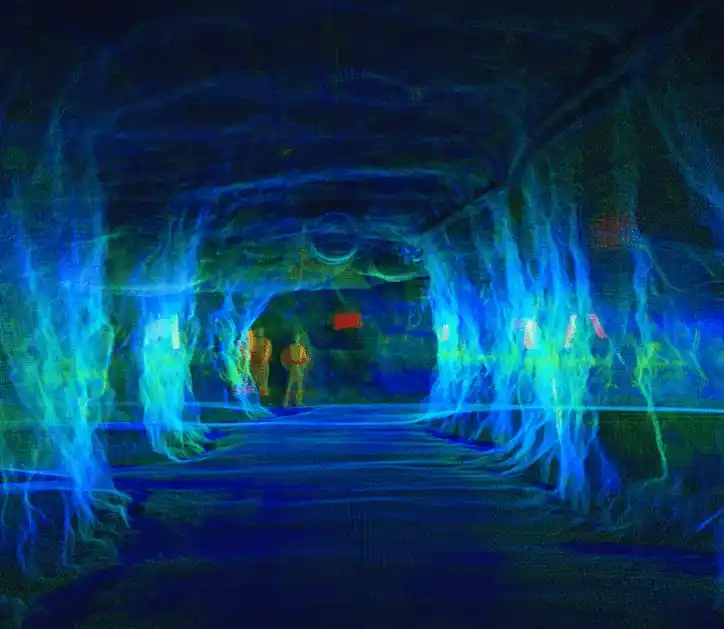
Technical buyers should be able to evaluate the output. Explore real SafeScanner point-cloud data and see the geometry your own survey, engineering or planning team would receive.
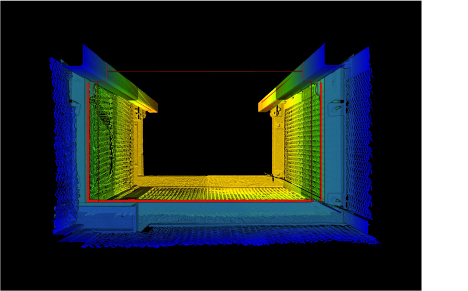
From Rock Face to Engineering Data.
SAFESCANNER
CAPTURE
High-density underground 3D geometry
MINE SOFTWARE
USE
Move relevant data into established survey, engineering and planning workflows
Control the Capture.
See the Point Cloud Form.
SafeScanner works with the SafeSight Control App to give the operator direct control over compatible scanning workflows.
Start and stop capture, monitor the developing point cloud and export supported scan data without waiting until the entire workflow reaches the office.
Explore the Control AppRaw Capture Is Only the Beginning.
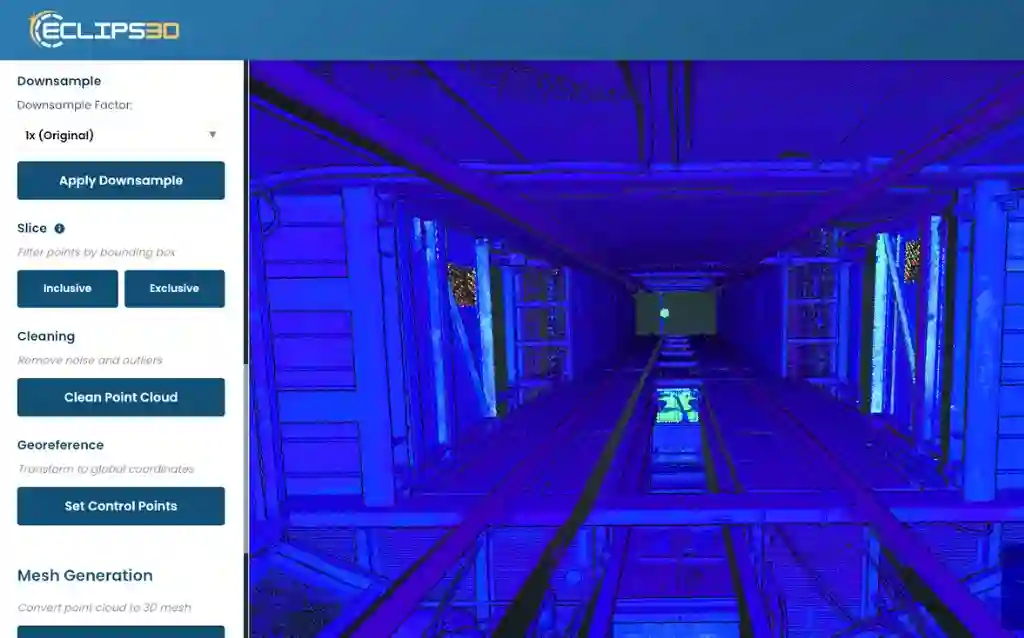
Eclipsed is SafeSight's point-cloud processing layer.
Move raw spatial data from SafeScanner into a workflow for cleaning, geo-referencing, downsampling, meshing and measurement before the geometry enters downstream technical systems.
Explore Point Cloud ProcessingBuild a Mine Data History, Not a Folder of Scans.
NimbVault provides the visualization and organizational layer for SafeSight spatial data.
Store repeated underground scans within a structured mine hierarchy, review geometry in the browser and create a more traceable spatial record of the operation.
Explore NimbVault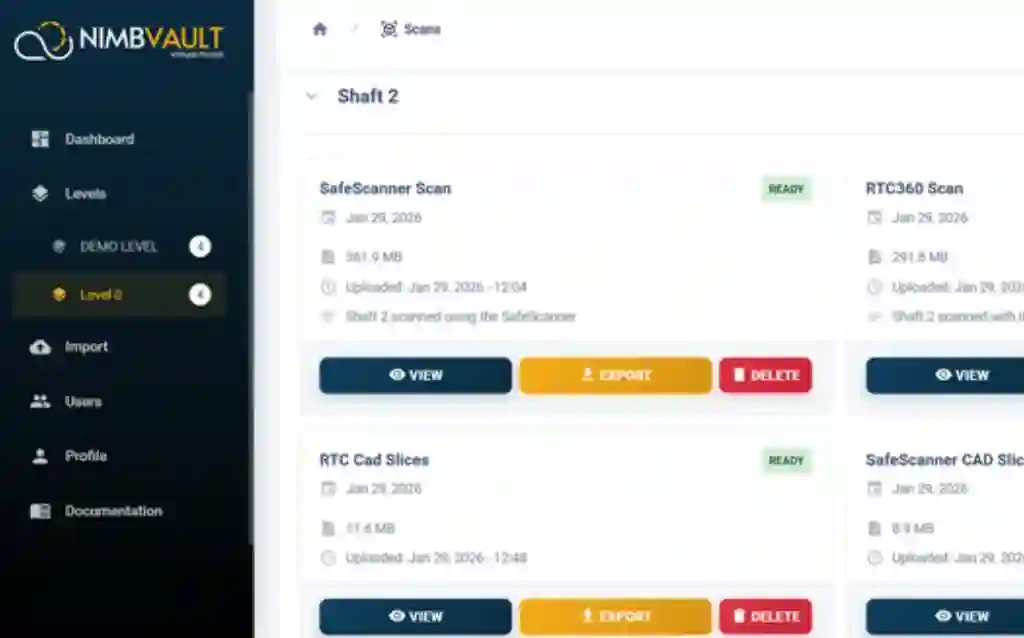
SafeScanner Technical Specifications
| Accuracy | ±5 mm |
|---|---|
| Scan Speed | 5.2 million points / second |
| Published Range | 0–100 m |
| Field of View | 90° |
| Output Formats | LAS, LAZ, E57, PCD, PLY, PTS, XYZ, OBJ |
LiDAR Range Is Not the Same as Mapping Distance
A scanner's published LiDAR range describes the measurement distance between the sensor and surrounding surfaces under the specified operating conditions.
It does not necessarily describe the total distance that a mobile scanner can travel during a mapping run.
When SafeScanner moves through a drift, ramp or other route, the scanner continually observes new surrounding geometry as the capture platform progresses.
Use the Data in the Technical Workflow You Already Have.
SafeScanner should not require a mine to abandon the software environment it already uses. Supported point-cloud and model outputs can move into SafeSight software or established third-party mine, CAD and reality-capture workflows.
SafeScanner for Mine Shaft Scanning
Mine shafts require a different capture strategy from horizontal development.
SafeScanner can be deployed in shaft scanning configurations to capture dense vertical geometry for measurement and infrastructure assessment.
Potential outputs can support review of:
- guide geometry and alignment;
- face-to-face dimensions;
- buntons and dividers;
- guide width and depth;
- repeated shaft-condition records.

In-Motion LiDAR for Drifts and Ramps
Long underground routes are one of the clearest applications for mobile LiDAR capture.
SafeScanner can move through suitable drifts and ramps while continuously recording surrounding geometry, reducing the need to treat every section of the route as an isolated static scan.
Use cases can include:
- development documentation;
- clearance and as-built records;
- infrastructure mapping;
- design comparison;
- repeated spatial capture;
- drift scanning;
- ramp scanning.
Use the Deployment Method That Fits the Underground Route
Where personnel can safely walk the route, an operator-carried SafeScanner configuration provides a flexible way to collect detailed 3D geometry without requiring a vehicle or robotic platform. Vehicle, rover and operator-carried configurations extend SafeScanner into mobile LiDAR mapping workflows across suitable underground routes.
SafeScanner is SafeSight's underground specialist within a broader family of 3D LiDAR scanning and reality-capture configurations.
When Does In-Motion LiDAR Make Sense Underground?
Static scanning remains appropriate for many mine-survey tasks. In-motion LiDAR becomes especially valuable when the geometry or workflow rewards mobility.
Consider a mobile approach when:
- the route is long;
- multiple static positions would otherwise be required;
- development changes frequently;
- field time is limited;
- repeated scanning is required;
- a moving platform can safely traverse the route;
- verifying coverage during capture adds operational value.
Consider a static approach when:
- the required area can be efficiently captured from a few stations;
- the survey specification is built around highly controlled static setups;
- mobile deployment provides no meaningful workflow advantage.
THE SAME WAY EVERYWHERE.
5.2 Million Points Per Second Means Nothing
If the Important Geometry Is Missing.
Point density is only one part of scan quality. A useful underground dataset also depends on sensor position, visibility, route selection, surface geometry, capture speed, environmental conditions, registration, processing, and coverage.
This is why SafeScanner combines mobile capture with real-time visualization. The goal is not simply to generate more points.
The goal is to bring back the geometry the technical team needs.
Related Technical Reading
LiDAR Scanners in Mining: Market Trends and In-Motion Mapping
Why mining operations are moving toward faster, mobile LiDAR capture and how in-motion scanning changes the underground mapping workflow.
Read the LiDAR Scanner GuideUnderground Mapping Applied: In-Motion LiDAR in the Field
A published SafeSight field perspective comparing mobile LiDAR capture with a traditional cavity-monitoring workflow for underground stope mapping.
Read Map-"Ability"How to Choose the Right Mine Shaft Scanner
A practical overview of shaft-scanning methods, LiDAR deployment options and the factors mines should evaluate when selecting a capture system.
Read the Buying GuideBest Practices for Underground Mine Shaft Mapping
How modern LiDAR capture supports accurate shaft geometry, repeatable measurement and long-term infrastructure records.
Read the Shaft Mapping GuideFrom Rock Face to Real Time (White Paper)
A deep dive into how in-motion 3D LiDAR is changing the speed and clarity of underground mapping workflows.
Read the White PaperSafeSight 3D LiDAR Ecosystem Demo
Watch a 90-second overview of SafeSight's capture hardware and processing workflow.
View a Shaft Survey ExampleNeed the Underground Environment Scanned
Rather Than the Scanner?
Some operations want to own and operate SafeScanner internally. Others need the finished spatial data. SafeSight can support underground scanning projects using the capture platform suited to the environment.
Own the Technology or Start With a Project.
BUY + OPERATE
Deploy SafeScanner within your own survey or technical team with SafeSight product training and support.
PROJECT-BASED SCANNING
Use SafeSight's technical team for a defined underground mapping requirement.
TRANSITION TO INTERNAL CAPABILITY
Start with SafeSight-supported implementation and build an internal repeatable workflow over time.
SafeScanner Underground LiDAR FAQs
What is SafeScanner?
SafeScanner is SafeSight's modular 3D LiDAR capture system for underground and mobile mapping workflows. It can be configured for different deployment methods depending on the environment and required spatial data.
Is SafeScanner an underground LiDAR scanner?
Yes. SafeScanner is designed for underground 3D LiDAR capture and can support mine mapping applications including drifts, ramps, shafts and other suitable environments.
What is SafeScanner's accuracy?
SafeSight currently publishes a ±5 mm accuracy specification for SafeScanner. Actual project results depend on the capture environment, deployment method, registration, processing and survey requirements.
How fast does SafeScanner collect LiDAR data?
SafeSight currently publishes a scan rate of up to 5.2 million points per second for SafeScanner. Point rate should be considered together with coverage, positioning and final data quality rather than treated as a standalone measure of survey performance.
What is SafeScanner's LiDAR range?
The current published SafeScanner specification lists a 0–100 m range. This measurement range should not be confused with the total distance a mobile scanner can travel during an underground mapping run.
Can SafeScanner scan while moving?
Yes. SafeScanner is designed around in-motion LiDAR capture for compatible deployment configurations.
Can SafeScanner be used handheld?
SafeScanner can be configured for operator-carried capture in appropriate environments. Detailed handheld and portable LiDAR application information will be provided through SafeSight's dedicated configuration resources.
Can SafeScanner be mounted on a vehicle?
Yes. Vehicle-mounted SafeScanner configurations can support mobile capture across suitable underground drifts, ramps and other linear routes.
Can SafeScanner be used on a robot?
SafeScanner can be deployed with DeepTraxx for compatible ground-based remote mapping applications.
Can SafeScanner be used on an underground drone?
SafeScanner is used within SafeSight's DBV underground mapping ecosystem for compatible aerial LiDAR capture applications.
Can SafeScanner scan a mine shaft?
SafeScanner can support mine-shaft capture configurations. SafeSight also provides dedicated mine-shaft inspection and measurement services for projects requiring shaft-specific analysis and outputs.
Can I see the point cloud while scanning?
SafeSight's Control App supports Live Render for compatible SafeScanner workflows, allowing the operator to view the developing point cloud and evaluate scan coverage during capture.
What file formats does SafeScanner produce?
SafeSight's current published compatibility information includes common point-cloud formats such as LAS, LAZ, E57, PCD, PLY, PTS, XYZ and OBJ.
Does SafeScanner replace terrestrial laser scanning?
Not necessarily. Static terrestrial scanning remains an appropriate method for many surveying applications. SafeScanner provides an in-motion option for environments where mobility, route length, repeated capture or real-time verification offer practical advantages.
What happens to the scan after capture?
Compatible SafeScanner data can be reviewed through the SafeSight Control App, processed using Eclipsed, managed and visualized in NimbVault and exported into established mine-planning, CAD and point-cloud workflows.
EXPLORE UNDERGROUND LIDAR SCANNING
What Is an Underground LiDAR Scanner?
An underground LiDAR scanner is a spatial-data capture system that uses laser measurements to create a three-dimensional representation of mine workings and underground infrastructure.
The scanner repeatedly measures the distance between the sensor and surrounding surfaces. As measurements accumulate, they form a point cloud representing the geometry of the environment.
Underground LiDAR can support applications including development mapping, shaft measurement, clearance analysis, infrastructure documentation, reconciliation and repeated spatial records.
The appropriate scanner and deployment method depend on the environment, required accuracy, access conditions and intended technical output.
How Does In-Motion LiDAR Scanning Work Underground?
Traditional terrestrial scanning normally collects spatial information from controlled stationary positions.
In-motion LiDAR instead allows the capture system to travel through the environment while recording surrounding geometry.
Depending on the application, a mobile scanner may be:
- carried by an operator;
- mounted on a vehicle;
- carried by a ground robot;
- integrated with an aerial platform;
- mounted within a specialized vertical capture configuration.
The advantage is not simply movement. The advantage is the ability to capture spatial information continuously across routes or environments where repeated static setups may slow the overall workflow.
Mobile LiDAR vs Terrestrial Laser Scanning Underground
The choice between mobile and static scanning should be based on the survey objective rather than a blanket assumption that one technology is always superior.
Static terrestrial laser scanning may provide an excellent approach for controlled high-detail capture from defined locations.
Mobile LiDAR can be advantageous for long routes, frequent repeat capture or environments where many individual static stations would otherwise be required.
Some mine-survey programs may use both.
The correct approach depends on accuracy requirements, route geometry, visibility, field time, control requirements, repeatability, and downstream engineering needs.
What Affects Underground LiDAR Accuracy?
Published scanner accuracy is only one part of the final survey result.
Underground LiDAR quality can also be influenced by surface distance, geometry, capture movement, registration, environmental conditions, sensor configuration, control methodology, processing, and project requirements.
For this reason, product specifications should be evaluated together with real sample data and the intended field workflow.
SafeSight should make real SafeScanner data available so technical teams can evaluate whether the output is suitable for their use case.
What Does a LiDAR Point Cloud Tell a Mine?
A point cloud is a collection of three-dimensional measurements representing surfaces within the scanned environment.
In underground mining, point clouds can be used to examine shape, distance, dimensions, clearances, excavation geometry, infrastructure, and changes over time.
After processing, point-cloud data can also support derived models, meshes, sections and measurements used within engineering and mine planning workflows.
Why Verify a LiDAR Scan Underground?
Discovering incomplete scan coverage after the survey team has left the area can create another underground trip.
Real-time visualization allows operators to evaluate the developing dataset while capture is still underway.
This does not guarantee that every survey requirement has been met. It gives the operator another tool for identifying potential coverage gaps before ending the capture workflow.
When Might SafeScanner Not Be the Right Capture Method?
SafeScanner should not be positioned as the answer to every underground survey.
A different approach may be more appropriate when:
- a small area can be efficiently captured from one static position;
- project specifications require another surveying method;
- the environment cannot support the proposed mobile platform;
- aerial geometry requires DBV;
- an Alimak rail application is better suited to Rail Runner;
- a specialized ground inspection requires DeepTraxx;
- the technical outcome is already efficiently achieved using another existing survey method.
SafeSight should select the capture method according to the environment and required result.
See the Data Before You Decide on the Scanner.
Specifications describe the hardware. The point cloud shows what your technical team can actually work with.
Explore real SafeScanner data, review the workflow and determine whether in-motion underground LiDAR fits your mine.