Introduction
The mining industry has seen a significant transformation with the integration of drone technology. Drones for mining exploration are reshaping how companies conduct surveys, analyze geological formations, and improve operational efficiency. With the ability to access remote and hazardous locations, these aerial devices are proving to be indispensable tools. This blog explores the benefits, applications, and technological advancements of drones in mining exploration, answering key questions such as “Can drones be used for mining exploration?” and “What is the best drone for mining exploration?”
How Drones Are Transforming Mining Exploration
Drones have revolutionized mining exploration, offering unparalleled efficiency, accuracy, and safety in surveying, mapping, and mineral analysis. With cutting-edge technology such asLiDAR-equipped drones,thermal imaging drones, andunderground drones, mining companies can optimize operations while reducing costs and environmental impact.
Key Applications of Drones in Mining Exploration
- Aerial Surveys and Mapping
- Drones with high-resolution cameras andLiDAR sensors generate accurate 3D maps for better planning and analysis.
- Drone construction mapping improves site development and infrastructure planning.
- Geological Surveys
- Drones for geological surveys analyze soil composition and mineral-rich areas, aiding in early-stage exploration.
- Multispectral and hyperspectral imaging helps detect hidden mineral deposits.
- Underground Mining Exploration
- Underground drones inspect and map tunnels, reducing human risk and improving efficiency.
- Drones for stope mining navigate confined spaces to capture critical data.
- Safety Inspections & Emergency Response
- Underground mining safety equipment anddrone emergency response solutions enhance worker safety.
- Mining rescue pack andrescue wheel support rapid response in emergencies.
- Thermal sensor drones for search and rescue operations assist in locating missing workers.
- Stockpile Measurement & Resource Management
- Drones in mining enable precise stockpile measurement, reducing human error and improving inventory management.
- GPS and RTK technology ensure highly accurate data collection.
SafeSight Exploration’s DB4 and DeepTraxx are state-of-the-art drone and robotic technologies designed to optimize mining exploration, surveying, mapping, and 3D modeling. These solutions enhance efficiency, safety, and data accuracy in both surface and underground mining operations.
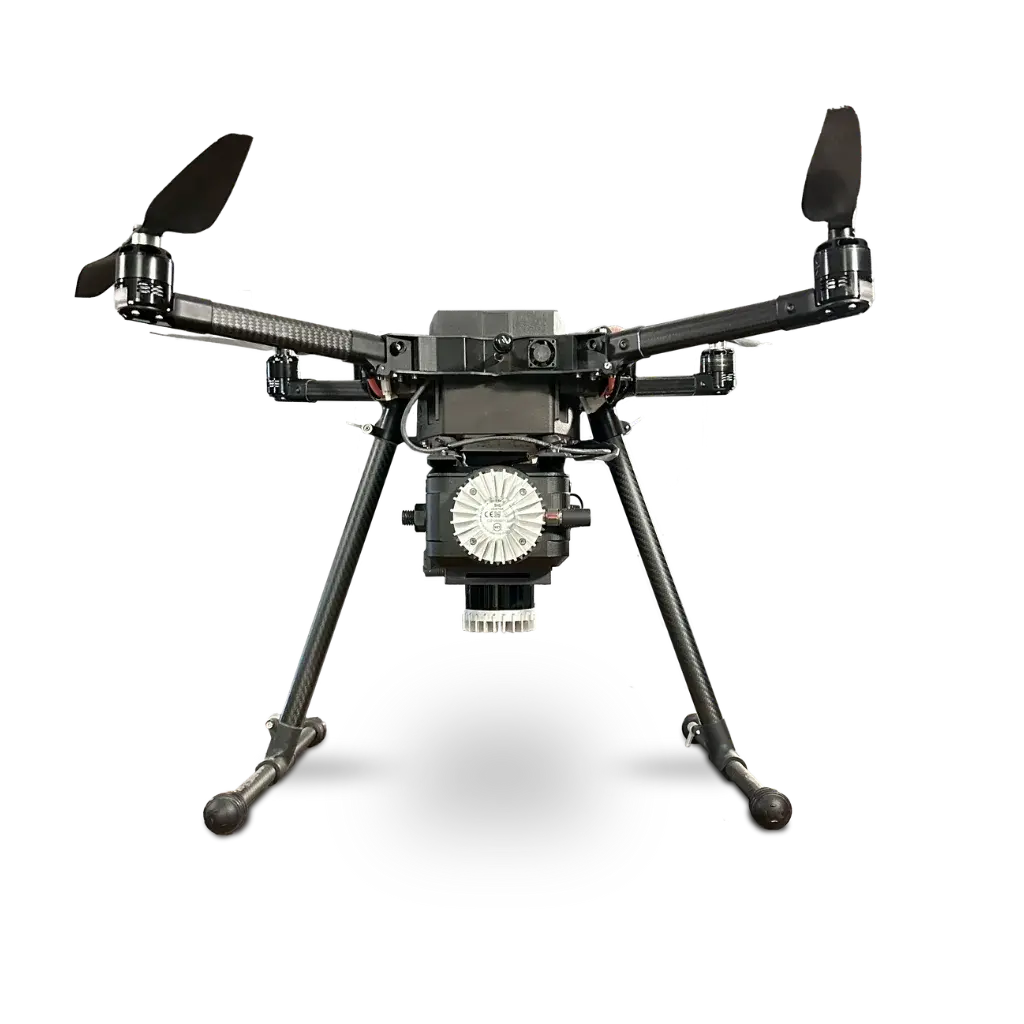
How SafeSight’s DB4 and DeepTrax can be used for Mining Exploration?
DB4 – Aerial Drone for Mining Exploration
The DB4 is a high-performance drone equipped with advanced sensors for comprehensive surface exploration and mapping.
- LiDAR Technology – Creates highly accurate topographic maps for mine planning and terrain analysis.
- Real-Time Data Processing – Enables faster decision-making with high-resolution imaging and analytics.
- Safety & Efficiency – Reduces human exposure to hazardous environments and speeds up survey processes.
DeepTraxx – Ground-Based Robotic System for Underground Mining
The DeepTraxx is a rugged, autonomous robotic vehicle designed for underground and confined-space mining exploration.
- LiDAR Scanning & HD Cameras – Captures high-resolution 3D models of underground tunnels and shafts.
- Navigation – Moves through complex mining environments with precision.
- Structural Integrity Inspection – Identifies weaknesses in tunnels, improving mine safety.
- Hard-to-Reach Areas – Provides access to hazardous or inaccessible underground spaces.
- Operational Cost Reduction – Lowers the need for human intervention in dangerous conditions.
By integrating DB4 and DeepTraxx, mining companies can enhance exploration accuracy, improve safety standards, and optimize resource evaluation. These technologies provide a comprehensive, data-driven approach to modern mining, making exploration more efficient and cost-effective.
Advanced Drone Technology in Mining
Modern drones are equipped with specialized sensors and software to maximize efficiency in mining operations:
- LiDAR Sensors – Create precise 3D models of mining sites.
- Multispectral & Hyperspectral Cameras – Analyze vegetation and mineral composition.
- Thermal Imaging – Detects temperature variations indicating mineral presence.
- Reconnaissance UAVs – Conduct aerial surveys for remote mining exploration anddrone disaster management.
Cost of Using Drones for Mining Exploration
The investment in drones for mining exploration varies depending on technology and operational needs:
- LiDAR-equipped drones: $10,000 – $100,000
- Software & data processing: Subscription-based costs
- Training & maintenance: Additional expenses
Despite the initial investment, drones drastically reduce operational costs, labor expenses, and survey time.How Drones Improve Mining Exploration
Using drones in mining exploration provides several benefits:
- Faster Data Collection – Surveys completed in hours instead of weeks.
- Enhanced Safety – Reduces human exposure to hazardous conditions.
- High Accuracy – Advanced sensors improve data reliability.
- Cost Efficiency – Minimizes the need for on-site labor and expensive machinery.
- Environmental Benefits – Less invasive than traditional exploration methods.
Why Mining Companies Should Use Drones
The mining industry faces increasing demands for efficiency and sustainability. Drones for mining exploration provide a game-changing solution by:
- Reducing reliance on heavy machinery in initial exploration.
- Lowering carbon emissions compared to traditional survey methods.
- Enablingreal-time emergency response mapping data.
- Enhancing decision-making with real-time aerial reconnaissance data.
- Improving productivity while ensuring underground mining safety.
With rapid advancements in drone technology for mining, companies that leveragedrones for fire departments,thermal imaging for wildfire detection, and emergency response applications will stay ahead of the competition. By integrating AI-driven drones withmining industry fall protection solutions, mining operations can achieve new levels of efficiency, safety, and profitability.
What Sensors Do Mining Drones Use?
Mining drones are equipped with a variety of advanced sensors that enhance exploration, mapping, and mineral detection. These sensors provide critical data that help mining companies make informed decisions while improving safety and efficiency. Below are the key types of sensors used in mining drones and their applications:
- LiDAR (Light Detection and Ranging) Sensors – LiDAR sensors use laser pulses to create highly accurate 3D maps of terrain and underground environments. These are essential for detailed topographic mapping, pit monitoring, and detecting structural weaknesses in tunnels.
- Magnetometers – Magnetometers measure variations in the Earth’s magnetic field to locate magnetic mineral deposits, such as iron ore and nickel. This helps geologists identify areas with high mining potential.
- Hyperspectral Sensors – These sensors analyze a broad spectrum of light wavelengths to detect the unique spectral signatures of different minerals. They are particularly useful for identifying ore deposits, mapping rock types, and assessing soil composition.
- Thermal Imaging Sensors – Thermal cameras detect temperature differences on the ground, which can indicate geological anomalies, mineralized zones, or even underground water sources. This data is valuable for identifying hidden mineral deposits and monitoring mine site conditions.
- Multispectral Sensors – Similar to hyperspectral sensors but with fewer spectral bands, multispectral cameras are used for vegetation analysis, environmental monitoring, and assessing the impact of mining operations.
The Future of Mining Drones
Drones are transforming the mining industry by providing safer, faster, and more cost-effective solutions for exploration and monitoring. The integration of AI and machine learning with drone technology allows for real-time data processing, enhancing decision-making and operational efficiency. Additionally, advancements in battery life, autonomous flight capabilities, and data transmission are making mining drones even more effective tools for modern exploration.
As the technology continues to evolve, drones will play an increasingly critical role in mineral discovery, resource estimation, and environmental management, ultimately shaping the future of mining operations worldwide.
What is mining exploration?
Mining exploration is the process of searching for valuable minerals or ores in the Earth’s crust. It involves geological surveys, remote sensing, drilling, and sampling to assess the potential for mining operations.
What are the main methods used in mineral exploration?
Common methods include geological mapping, geochemical analysis, geophysical surveys (such as magnetometry and seismic testing), remote sensing, and exploratory drilling.
How long does the mining exploration process take?
The duration varies depending on the complexity of the site and available data. It can take several months to years to complete the exploration phase and determine if mining is viable.
What challenges do mining companies face during exploration?
Challenges include difficult terrain, high costs, environmental regulations, data accuracy, and the risks of not finding commercially viable mineral deposits.
How are drones used in mining exploration?
Drones are used for aerial mapping, geological surveys, mineral detection, stockpile monitoring, safety inspections, and environmental assessments, improving efficiency and reducing risks for workers.
What types of sensors do mining drones use?
Mining drones utilize LiDAR, magnetometers, hyperspectral and multispectral cameras, thermal sensors, and high-resolution imaging systems to collect geological and mineralogical data.
What are the advantages of using drones in mining exploration?
Drones provide safer, faster, and more cost-effective exploration by covering large or hazardous areas quickly, collecting high-resolution data, and reducing the need for human presence in dangerous locations.
Can drones be used for underground mining exploration?
Yes, specialized drones with obstacle avoidance, LiDAR mapping, and infrared cameras can navigate underground tunnels to inspect conditions, map voids, and identify structural weaknesses.
What is the future of drones in the mining industry?
The future of mining drones includes AI-powered analytics, autonomous flight technology, enhanced battery life, and improved real-time data processing, making them indispensable tools for exploration, monitoring, and safety.